

Guided by the National Audit Office, Nanjing Audit University continues to build the "Study Auditing in China" brand, cultivating auditing professionals who understand and are friendly toward China for countries participating in the Belt and Road Initiative.
Recently, research papers by Gilbert Simson Gattang from Indonesia and Fatmata Binta Bah from Sierra Leone, two international students in the 2024 Master of Auditing program at Nanjing Audit University, were accepted for publication in the 2026 Issue 1 of Auditing Research. Their work not only offers an academic perspective on their profound understanding of China's research-oriented auditing experience, but also uses auditing as a window to present China's governance solutions, marking a significant step in their journey of "understanding China."
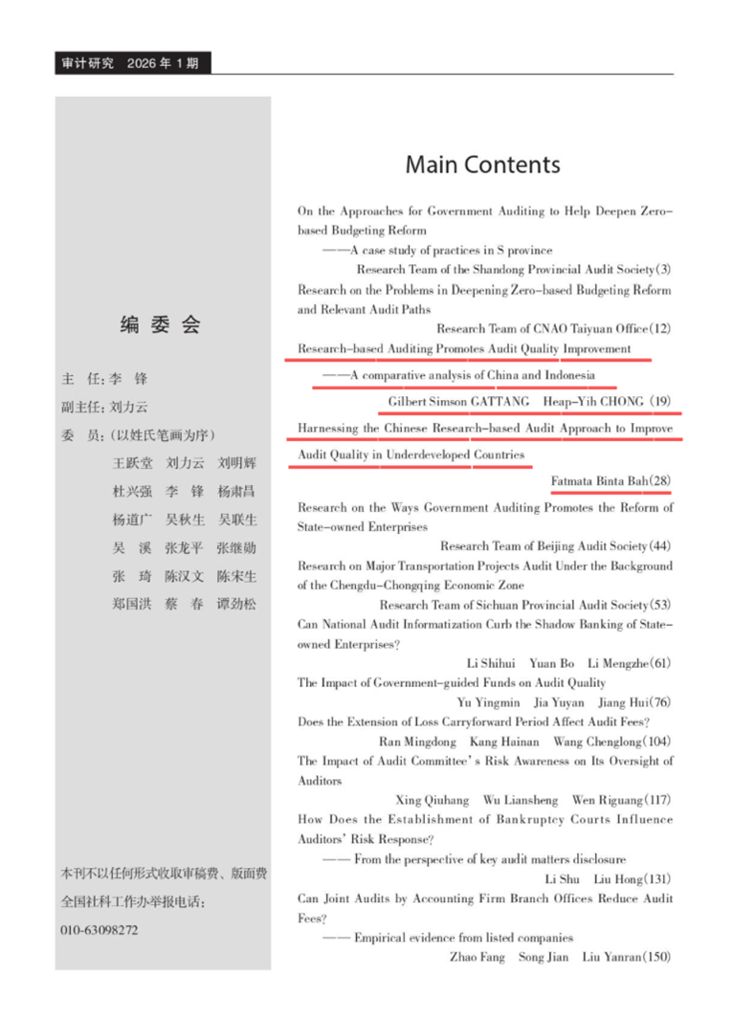
Enhancing audit quality through research-based practices
——a comparative study of China and Indonesia

Gilbert Simson Gattang (Indonesia)
Heap-Yih CHONG
Abstract: Research-based auditing can improve auditing and governance, but so far, cross-national comparative analyses remain limited. This paper compares research-based auditing approaches in China and Indonesia, focusing on their methodologies, implementation, and impact on governance. Through a literature review and interviews with key stakeholders, differences between the two countries’ approaches are revealed. In China, the integration of the ‘political big picture-policies-projects-funds’ and ‘funds-projects-policies-political big picture’ frameworks ensures consistency between government policies and local implementation, thereby improving audit quality and promoting governance reform. Meanwhile, Indonesia continuously optimizes research methods in auditing, characterized by special audits and data-driven approaches, showing effectiveness in addressing the complexities of national fiscal governance. The study results indicate that auditing should be based on the nation’s developmental realities and specific audit environments, while emphasizing the value of research-based auditing in achieving national development goals and the United Nations Sustainable Development Goals.
Keywords: research-based audit, governance reform, Supreme Audit Institutions, United Nations Sustainable Development Goals
Harnessing the Chinese Research-based Audit Approach to Improve Audit
Quality in Underdeveloped Countries

Fatmata Binta Bah
Abstract: For years, China’s audit institutions have been committed to conducting “Research-Based Audits (RBA)” and have achieved remarkable results. Given the significant differences in national circumstances, it is difficult to replicate specific systems rooted in China, and yet RBA’s core methodological innovation—integrating systematic research throughout the entire audit process—possesses universal reference value. By comparing the implementation requirements of RBA with the actual auditing situation in underdeveloped countries, this paper analyzes key gaps in institutions, capacity, technology, and other aspects, considers that the RBA model holds significant value for enhancing audit quality in underdeveloped countries across four the key dimensions of strategic anchoring, systematic analysis and preventative governance, institutionalized accountability, and top-down technological empowerment, and constructs an adaptive transfer framework. It provides a feasible transformation pathway for Supreme Audit Institutions (SAIs) to improve audit quality and public accountability efficiency, and promote sustainable governance reforms.
Keywords: research-based audit, underdeveloped countries, audit quality, adaptive transfer